
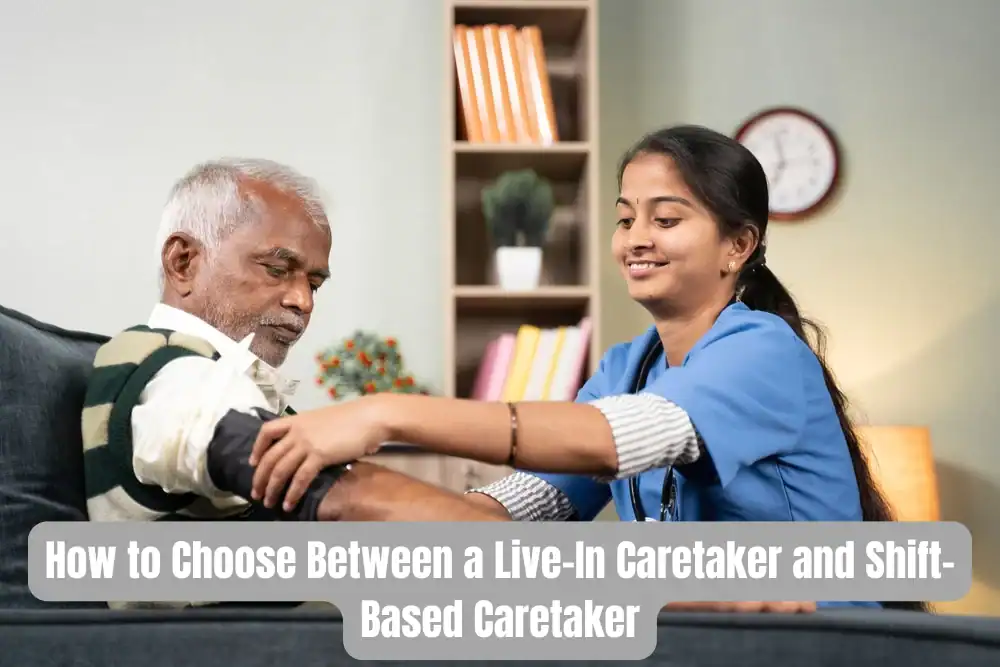
When an elderly parent starts needing regular help at home, one of the biggest questions families face is: Should we hire a live-in caretaker or arrange caretakers in shifts?
Both options can work well, but they serve different needs.
A parent who mainly needs help with bathing, meals, walking, and daytime activities may not require someone around throughout the night. On the other hand, a bedridden senior, a person with advanced dementia, or someone who needs frequent assistance at night may require more continuous support.
The right choice depends on your parent’s health condition, mobility, night-time needs, level of dependence, home environment, and family availability.
This guide will help you understand the difference and choose the arrangement that works best for your family.
What Is a Live-In Caretaker?
A live-in caretaker stays in the elderly person’s home and provides assistance according to the agreed care arrangement.
They may help with:
- Bathing and personal hygiene
- Dressing and grooming
- Toileting
- Diaper care
- Feeding
- Walking and mobility
- Getting in and out of bed
- Companionship
- General supervision
- Medicine reminders
- Assistance with everyday routines
Because the caretaker stays in the home, this arrangement can provide greater continuity and familiarity for the elderly person.
However, live-in care does not mean one caretaker can work continuously for 24 hours without sleep or breaks. Families should clearly understand working hours, rest periods, weekly offs, and backup arrangements.
What Is Shift-Based Care?
With shift-based care, caretakers work for specific periods and another caregiver takes over when required.
For example, a family might arrange:
- Day shift
- Night shift
- 12-hour shifts
- Separate day and night caregivers
This arrangement can be useful for seniors who require active assistance throughout both the day and night.
It also allows caregivers to receive appropriate rest between duties.
The Main Difference
The simplest way to understand the two options is this:
Live-in care focuses on continuity and having a familiar caregiver staying in the home.
Shift-based care focuses on providing active support during defined hours, with different caregivers taking over when necessary.
Neither option is automatically better. The correct arrangement depends on the patient’s needs.
1. Consider How Independent Your Parent Is
Start by looking at what your parent can still do independently.
Can they:
- Walk without assistance?
- Use the bathroom alone?
- Bathe independently?
- Eat without help?
- Get in and out of bed?
- Remember medicines?
- Sleep safely through the night?
If your parent is reasonably independent and mainly needs assistance with certain daily activities, a live-in arrangement or limited-hour support may be sufficient.
If your parent requires frequent physical assistance throughout the day and night, shift-based care may be more appropriate.
2. Think Carefully About Night-Time Needs
Night-time requirements are often what determine the best arrangement.
Ask:
- Does your parent wake several times to use the bathroom?
- Do they need help getting out of bed?
- Do they become confused at night?
- Is there a high risk of falling?
- Do they wander because of dementia?
- Do they require frequent repositioning as part of their care plan?
- Is active observation required overnight?
If the caregiver needs to be awake and actively assisting frequently throughout the night, expecting the same live-in caretaker to provide full daytime care as well may not be practical or safe.
In such cases, separate day and night shifts may provide better continuity of alert care.
3. Consider Whether Your Parent Is Bedridden
Bedridden elderly patients can require significant physical assistance.
They may need help with:
- Changing position
- Bedside hygiene
- Diaper changes
- Feeding
- Toileting
- Transfers
- Changing clothes
- Keeping the bed and surrounding area clean
- Mobility where medically appropriate
If these needs occur frequently throughout the day and night, shift-based support may be more suitable.
If medical procedures are also required, the family may need a qualified home nurse in addition to a caretaker or attendant.
4. Consider Dementia and Alzheimer’s Care
A senior with dementia may require more supervision than someone with only physical weakness.
They may:
- Wander
- Try to leave the house
- Forget where they are
- Forget to eat
- Take medicines incorrectly
- Become confused at night
- Leave taps or appliances on
- Experience behavioural changes
If dementia is advanced and supervision is required around the clock, families should consider whether a shift-based arrangement would provide safer coverage.
Consistency is also important for dementia patients, so introducing too many different caregivers can sometimes be confusing. A well-planned schedule with a small, familiar care team can help.
5. Consider the Caregiver’s Need for Rest
This point is extremely important.
A live-in caretaker is not the same as a person who works actively for 24 hours every day.
Caregivers need:
- Proper sleep
- Meal breaks
- Personal time
- Weekly rest
- Time away from physically demanding responsibilities
A tired caregiver may be less alert and more likely to make mistakes.
If your parent genuinely requires frequent attention throughout 24 hours, using shifts is usually more practical than expecting one person to remain continuously available.
6. Think About Continuity and Familiarity
One major advantage of a live-in caretaker is familiarity.
Over time, the caretaker becomes familiar with:
- Your parent’s routine
- Food preferences
- Communication style
- Mobility limitations
- Sleeping habits
- Likes and dislikes
- Behavioural patterns
Your parent may also become more comfortable asking the same person for help with personal activities.
This can be particularly valuable for seniors who dislike frequent changes in caregivers.
With shift-based care, good communication between caregivers becomes especially important so that important information is not missed during handovers.
7. Consider Privacy at Home
Having someone living permanently in the home is a significant change.
Before choosing live-in care, consider whether:
- There is appropriate space for the caretaker
- Your parent is comfortable having someone stay in the house
- Other family members are comfortable with the arrangement
- The caretaker has a suitable place to rest
Some elderly people prefer having help during the day but want privacy at night.
In such situations, scheduled or shift-based care may be more comfortable.
8. Compare the Cost Carefully
Cost will naturally influence the decision, but families should compare the complete care requirement rather than only the monthly amount.
Ask the home healthcare provider about:
- Live-in caretaker charges
- Day-shift charges
- Night-shift charges
- 12-hour care charges
- Weekly offs
- Replacement charges, if any
- Holiday arrangements
- Additional requirements
Shift-based continuous care may cost more because multiple caregivers are involved.
However, if your parent genuinely requires active assistance throughout the day and night, choosing a cheaper arrangement that cannot safely meet those needs may create problems later.
9. Think About What Happens When the Caretaker Takes Leave
This question is particularly important with live-in care.
Ask:
- Who will help when the caretaker takes weekly leave?
- What happens if the caretaker becomes sick?
- Is replacement support available?
- How quickly can another caregiver be arranged?
- Will the replacement understand the patient’s routine?
Families should have a backup plan before an absence occurs.
10. Consider Family Availability
Your own availability also matters.
Suppose your parent needs help during the day, but a family member is always home at night. In that case, daytime care may be sufficient.
However, if the elderly parent lives alone and children live in another city or abroad, a more comprehensive care arrangement may provide greater reassurance.
The care plan should consider both the parent’s needs and the family’s ability to provide support.
When a Live-In Caretaker May Be Suitable
A live-in arrangement may work well when:
- The senior wants one familiar caregiver
- Daily assistance is required
- The parent needs companionship
- Help is needed with bathing and hygiene
- Mobility assistance is required
- The parent needs meal or feeding support
- Night-time needs are limited
- The caretaker can receive proper rest
- The home has suitable accommodation
For many elderly people, having a familiar person around can also reduce feelings of loneliness.
When Shift-Based Care May Be Better
Shift-based care may be more appropriate when:
- Active assistance is needed both day and night
- The patient has significant mobility limitations
- Frequent night-time assistance is required
- Advanced dementia creates continuous supervision needs
- The patient is highly dependent
- Care requirements are physically demanding
- One caregiver cannot reasonably manage the required hours
- The family wants clearly defined duty periods
Fresh, rested caregivers can be particularly important when the patient requires substantial physical assistance.
Live-In vs Shift-Based Care: Quick Comparison
| Factor | Live-In Caretaker | Shift-Based Caretaker |
| Caregiver | Usually greater continuity with one familiar person | Different caregivers cover defined shifts |
| Best suited for | Regular daily assistance and companionship | Higher or continuous care requirements |
| Night support | Limited by the caregiver’s need for sleep and rest | Dedicated night support can be arranged |
| Familiarity | Usually higher | Depends on the number of caregivers |
| Privacy | Caregiver stays in the home | Caregiver is present during assigned hours |
| Space required | Suitable sleeping/rest space is needed | Usually no live-in accommodation required |
| Handover | Less frequent | Clear handovers are important |
| Cost | Depends on care requirements and arrangement | May be higher when multiple shifts are required |
What About Medical Care?
Neither a live-in caretaker nor a shift-based caretaker should automatically be treated as a substitute for a qualified nurse.
If your parent requires:
- Injections
- Wound dressing
- Catheter care
- Feeding tube care
- Post-operative nursing
- Oxygen-related care
- Clinical monitoring
- Other prescribed medical procedures
you may need a qualified home nurse.
Some families use a caretaker for daily living assistance and arrange nursing visits or nursing shifts according to the patient’s medical requirements.
Questions to Ask Before Making the Decision
Before choosing either arrangement, ask yourself and the care provider:
- How much assistance does my parent need during the day?
- How often do they require help at night?
- Can they safely be left alone for any period?
- Is there a history of falls?
- Is there dementia or significant memory loss?
- Is the patient bedridden?
- Are medical procedures required?
- Can the live-in caretaker receive adequate sleep and rest?
- Who provides replacement during leave?
- Is my parent comfortable with the proposed arrangement?
- What are the complete charges?
- How will emergencies be handled?
Answering these questions usually makes the right choice much clearer.
How Lokseva Home Healthcare Can Help
At Lokseva Home Healthcare, we understand that every elderly person’s care requirements are different.
Some parents need a little assistance with their daily routine. Others need support for mobility, personal hygiene, feeding, or bedridden care. Some patients require more continuous supervision, while others may also need professional nursing care.
The right home care arrangement should therefore be based on the patient’s actual condition rather than choosing a fixed package simply because it is convenient.
Depending on the person’s requirements, families can consider support for:
- Elderly care
- Personal hygiene
- Bathing and dressing
- Mobility assistance
- Feeding
- Toileting and diaper care
- Bedridden care
- Companionship
- Post-hospital support
- Home nursing requirements
Our aim is to help families find a care arrangement that keeps their loved one safe, comfortable, respected, and properly supported at home.
Frequently Asked Questions
Is a live-in caretaker available 24 hours?
A live-in caretaker stays in the home, but this should not be understood as continuous active work for 24 hours. Caregivers require appropriate sleep, breaks, and rest. If active care is required throughout the day and night, shifts may be more suitable.
Is shift-based care better for bedridden patients?
It can be, particularly when the patient needs frequent assistance throughout both day and night. The exact arrangement should depend on the patient’s level of dependence and medical needs.
Which option is better for a dementia patient?
It depends on the stage of dementia. Familiarity can be helpful, but patients who wander or require continuous supervision may need a more comprehensive shift-based care plan.
Can I have a female live-in caretaker for my elderly mother?
Depending on availability, families may request a female caretaker, particularly when the elderly woman requires assistance with bathing, dressing, toileting, and other personal activities.
Can we change from live-in care to shift-based care later?
Yes. Care needs can change as an elderly person’s health changes. The arrangement should be reviewed periodically and adjusted when necessary.
Conclusion
There is no single answer to whether a live-in caretaker or shift-based caretaker is better.
If your parent mainly needs companionship and regular help with daily activities, and the caregiver can receive adequate rest, a live-in arrangement may work well.
If your parent requires frequent assistance throughout both day and night, separate shifts may provide safer and more consistent support.
Most importantly, do not choose based only on convenience or cost. Look at your parent’s health, mobility, night-time requirements, safety, comfort, and level of dependence.
The best care arrangement is the one that allows your parent to remain at home with dignity, safety, comfort, and dependable support, while giving your family confidence that someone is there when help is needed.